Views: 4 Author: Site Editor Publish Time: 2026-02-06 Origin: Site
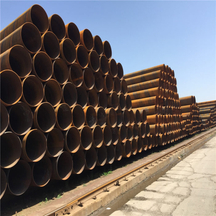
Thick-walled spiral welded steel pipes are welded using an electric arc welding method under a flux layer. The heat generated by the electric arc burning between the flux and welding wire under the flux layer melts the base metal and the welding wire/fluid, forming the weld.
During use, the equivalent defect length in the principal stress direction (i.e., the direction along the pipe axis) of a thick-walled spiral welded steel pipe is smaller than that of a straight-seam pipe; for example, if the pipe length is L, then the weld length is L/cos(θ). The long-standing debate between spiral welded steel pipes and straight seam welded steel pipes has several points. First, because defects are parallel to the weld seam, the weld defects in thick-walled spiral welded steel pipes are considered "oblique defects." Second, since pipeline steel is made from rolled steel plates, its impact toughness exhibits significant anisotropy; the CVN value along the rolling direction can be three times higher than the CVN value perpendicular to the rolling direction. Furthermore, spiral welded steel pipes have longer weld seams than straight seam pipes, and the question of which is superior, especially compared to UOE steel pipes, requires a comprehensive and accurate evaluation and comparison, given the current state of spiral welded steel pipe manufacturing technology. We should re-evaluate and reconsider the issue of the longer weld seams in spiral welded steel pipes.
The principal stress on thick-walled spiral steel pipes is perpendicular to the direction of the pipe's impact resistance. Spiral submerged arc welded steel pipes are made by bending hot-rolled strip steel into a spiral shape and welding the inner and outer seams using submerged arc automatic welding. The spiral shape deviates from the direction of the pipe's impact resistance, turning the disadvantage of long weld seams into an advantage. Thick-walled spiral steel pipes are widely used in the production of large-diameter steel pipes for the following reasons:
1) Because of continuous bending, the fixed length of the spiral steel pipe is not limited.
2) By changing the forming angle, thick-walled spiral steel pipes of various diameters can be produced from strip steel of the same width;
3) It is easy to change dimensions, making it suitable for the production of small batches and multiple varieties of thick-walled spiral steel pipes;
4) The spiral weld seam is evenly distributed across the entire circumference of the thick-walled spiral steel pipe, resulting in high dimensional accuracy and strength.
About Us / News / Product / Project / Quality Assurance / Service / Contact Us