Views: 3 Author: Site Editor Publish Time: 2026-03-06 Origin: Site
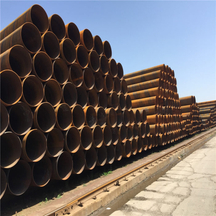
Spiral welded steel pipes are mainly used as fluid pipes and piling pipes. After manufacturing, if the spiral welded steel pipe is used for water transport, anti-corrosion treatment is generally applied to either the inner or outer surface. Common anti-corrosion treatments include 3PE anti-corrosion, epoxy coal tar anti-corrosion, and epoxy powder anti-corrosion. However, due to adhesion problems, epoxy powder coating has not been widely adopted. Recently, with the successful development of a special phosphating solution for epoxy powder coating, the adhesion problem of epoxy powder coating has been overcome for the first time, leading to the emergence of epoxy powder coating as a new process.
Analysis of the causes of uneven anti-corrosion coating thickness in spiral welded steel pipes: The uneven thickness of the 3PE spiral welded steel pipe coating is primarily manifested in the uneven thickness of the test points distributed along the circumference. The industry standard SY/T0413-2002 does not specify uniformity of thickness, only the coating thickness value, but requires that the coating thickness value cannot be lower than the thickness value of a single point, not the average of multiple test points.
If the coating thickness is uneven during the coating process of spiral steel pipes, it will inevitably lead to a waste of coating material. This is because while ensuring the thinnest part of the coating reaches the standard thickness, the thickness of the thicker parts will be significantly greater than the standard coating thickness. Moreover, uneven coating can easily result in the thinnest part of the steel pipe not reaching the standard coating thickness. The main reasons for uneven thickness during production are uneven material extrusion at several points and pipe bending. Effective methods to control the uneven coating of 3PE anti-corrosion spiral steel pipes include adjusting the extrusion dies to make the anti-corrosion coating thickness as uniform as possible at several points, and refraining from coating unqualified steel pipes.
About Us / News / Product / Project / Quality Assurance / Service / Contact Us